
A laundry room is one of those spaces that ends up doing far more than it was designed for. Washing machine, dryer, storage for cleaning products, somewhere to fold, somewhere to hang, a shelf that collects everything that has not found a home anywhere else. And all of this, more often than not, in a space that was never really planned as a room at all.
We fit shutters in a lot of homes across East London and we see this kind of space regularly. Narrow side returns in Hackney terraces. Rear extensions in Stoke Newington that were built to house a utility without much thought for how they would feel to spend time in. Compact galley rooms in Leyton and Walthamstow that are squeezed between the kitchen and the back door, doing essential daily work but somehow never quite belonging to the rest of the house.
What we have found, in homes like these, is that the window is almost always the starting point. Get the window treatment right and the room starts to feel considered. Leave it as an afterthought and even a well-organised utility space can feel like it is still waiting to be finished.
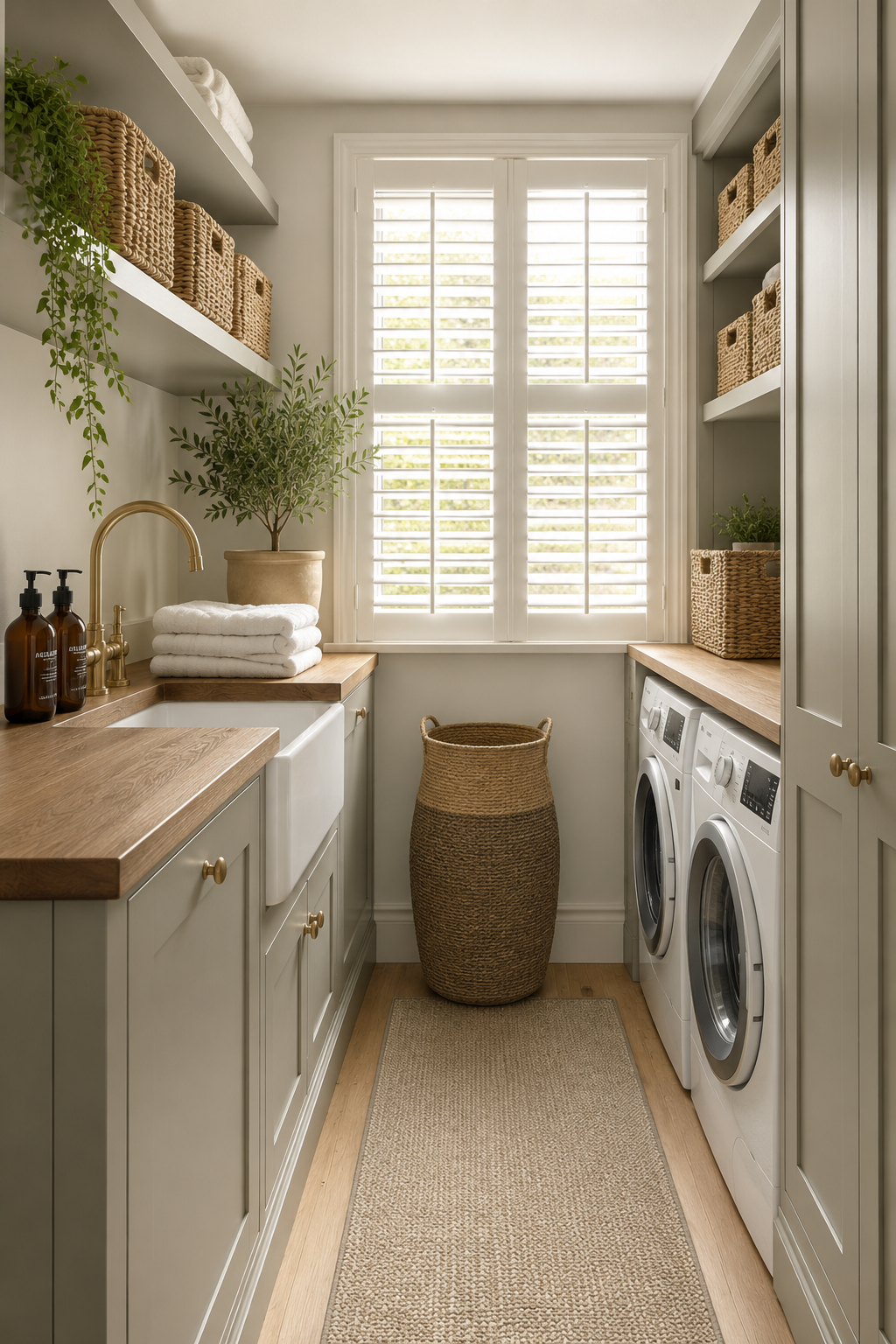
This scheme is our attempt to show how a small laundry room comes together properly, from the palette and the storage right the way through to the window. We have also linked to the products we used in the styling, so if you want to recreate any part of the look, you can find everything in one place.
Start with the window
Laundry rooms tend to face somewhere awkward. A neighbouring garden, a shared passageway, a side return that is overlooked from next door. Privacy is important, but so is light. In a room without much natural brightness, closing the window off entirely makes the space feel like a cupboard rather than a room.
Plantation shutters handle both. The louvres can be angled to pull in soft, diffused daylight while keeping the view in or out exactly where you need it. You are not choosing between one or the other. You are adjusting throughout the day depending on what the room needs.
For this scheme, the shutters are finished in Farrow and Ball 2005 All White. It is a soft, warm white that sits comfortably with pale cabinetry and natural materials. What it gives the window is a clean, architectural quality that makes the whole room feel more resolved, as though the window was designed into the room rather than added to it.
Build the palette from the back
Laundry rooms accumulate visual noise quickly. Appliances, bottles, baskets, products, drying racks. If the base palette is competing for attention, the room will always feel busy.
Here, the cabinetry is painted in Farrow and Ball Ammonite, a warm muted grey with enough depth to feel deliberate but still light enough to keep a compact space from closing in. Paired with All White shutters, it gives the room a gentle contrast that holds everything together without making the palette the point.
This kind of base works particularly well in period homes, where utility spaces were rarely planned and often awkward in shape. A consistent neutral foundation makes even a narrow or irregular room feel intentional rather than improvised.
Use natural texture to bring warmth through storage
Storage is what makes a laundry room actually function day to day, but it also shapes how the room feels to be in.
Woven baskets are one of the simplest ways to keep a compact utility space organised while adding warmth. They soften the harder lines of appliances and cabinetry, and they introduce a natural texture that painted surfaces alone tend to lack. In this scheme, seagrass baskets on open shelving hold laundry products, spare cloths and everyday household essentials. A tall slim laundry basket sits at the end of the galley. Practical, but also part of the composition.
The key is consistency. Use the same material across all your storage and the room starts to feel calm. Mix too many different basket types or container styles and the room starts to feel cluttered even when it is tidy.
Shop the look: seagrass baskets and laundry basket
Add a timber worktop
A worktop changes a laundry room more than you might expect. It gives you a practical surface for folding and sorting, and it creates a horizontal line that connects the appliances to the cabinetry in a way that feels considered.
Timber works well here because it introduces warmth without pulling attention. A pale oak or similar sits quietly alongside Ammonite cabinetry and All White shutters. It is a contrast, but a gentle one.
On the worktop in this scheme, the styling is kept deliberately minimal. Folded white towels, an amber hand wash bottle, a small plant near the window. Enough to make the room feel cared for without suggesting it is too precious to use. Anyone who has fitted out a laundry room knows that the moment it looks too styled is the moment the whole thing stops working properly.
Shop the look: towels, hand wash and hand cream
Choose appliances that sit within the scheme
Large white appliances are usually non-negotiable in a laundry room. The question is not how to hide them, but how to integrate them.
Positioning the washing machine and dryer beneath a continuous worktop helps significantly. The worktop brings them into the same horizontal composition as the cabinetry, rather than leaving them standing as separate functional objects within the room. In this scheme, clean white front-loading Bosch Series 6 machines sit beneath the timber surface, sitting quietly in the neutral palette rather than dominating it.
When we plan shutters in a room like this, we always look at how the window, worktop and appliances line up. When everything runs at a consistent height, even a compact galley space starts to feel more settled.
Shop the look: Bosch Series 6 washing machine and washer-dryer
Add the finishing details
There is a gap between a laundry room that functions and one that feels properly finished. Closing that gap usually comes down to a few small things done consistently.
A neutral runner along a galley floor adds warmth underfoot and helps define the walkway without claiming floor space. White towels stacked on a shelf rather than folded over a door. Amber bottles in place of whatever packaging the products came in. Simple brass or warm metal fittings on the cabinetry, rather than chrome.
None of these are large decisions, but together they give the room atmosphere. In a home that has been thought about carefully, that matters even in the spaces that do not often get visitors.
Shop the look: Rug
What the shutters do for the room
Stand back and the shutters are doing several things at once.
They manage light and privacy through the day. They give the window a fitted, finished quality that fabric or roller blinds rarely achieve in a working environment. They are easy to wipe down, which in a room that handles daily washing and cleaning is a more practical consideration than it might sound. And in terms of proportion, they frame the window in a way that anchors the whole room.
In the homes we work in across Hackney, Islington, Leyton, Walthamstow and East London more broadly, laundry rooms and utility spaces are often the last thing people think about when they are reworking a house. But they are usually the first rooms used each morning. Getting them right, even in quiet, practical ways, makes a difference that adds up over time.
Recreate the look
This laundry room is built around a straightforward set of layers: Ammonite cabinetry, All White shutters, natural woven storage, a warm timber worktop and a handful of everyday essentials styled with a little intention.
You can find everything linked in our laundry room here: East London Shutter Company Laundry Room
If you are thinking about shutters for a utility or laundry space, whether that is a compact side return, a rear extension or a room that is simply ready for a more considered finish, we are always happy to come and take a look. A home visit gives us a proper sense of the proportions, the light and what would actually work in the space.
The Verdict: What Do Shutters Do for a Working Laundry Room?
Stand back, and you will see that plantation shutters are doing several jobs at once:
- Light and Privacy: They manage changing daylight and neighborly privacy throughout the day.
- Durability: They give the window a fitted, permanent quality that fabric or roller blinds rarely achieve in a damp environment.
- Easy Cleaning: They are simple to wipe down, which is a major practical benefit in a room that handles daily dust, lint, and washing.
In the homes we work in across Hackney, Islington, Leyton, and Walthamstow, laundry rooms are often the last space people think about during a home renovation. Yet, they are often the first rooms used each morning. Getting them right makes a massive difference to your daily routine.
Frequently Asked Questions
Yes. Unlike fabric curtains or roller blinds, window shutters do not absorb moisture, odours, or dust from laundry appliances. They are incredibly easy to wipe clean and provide excellent ventilation when you need to air out the room.
Tier-on-tier or cafe style shutters are ideal for overlooked side returns and ground-floor extensions. They allow you to close the bottom section entirely for privacy from neighbours while keeping the top section open to flood the room with natural light.
Stick to a restrained, neutral colour palette (such as warm greys and soft whites) and use continuous lines. Running a worktop seamlessly over your washing machine and matching your window shutters to your wall colour will make a narrow room feel significantly wider and more cohesive.